
Paubha Paintings
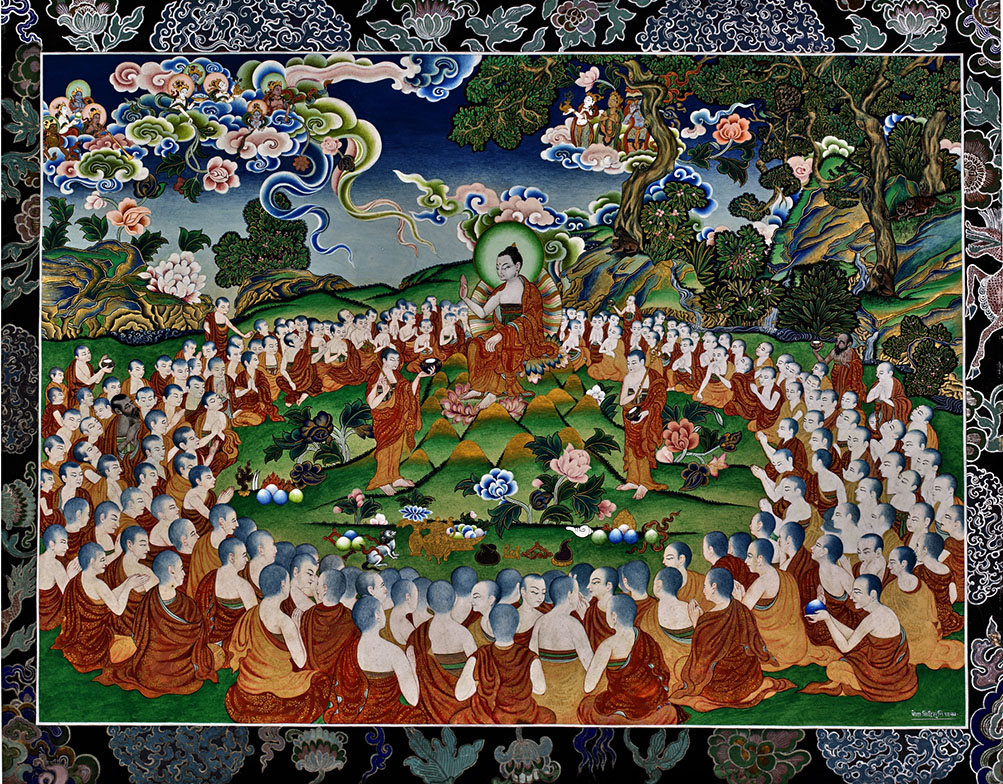
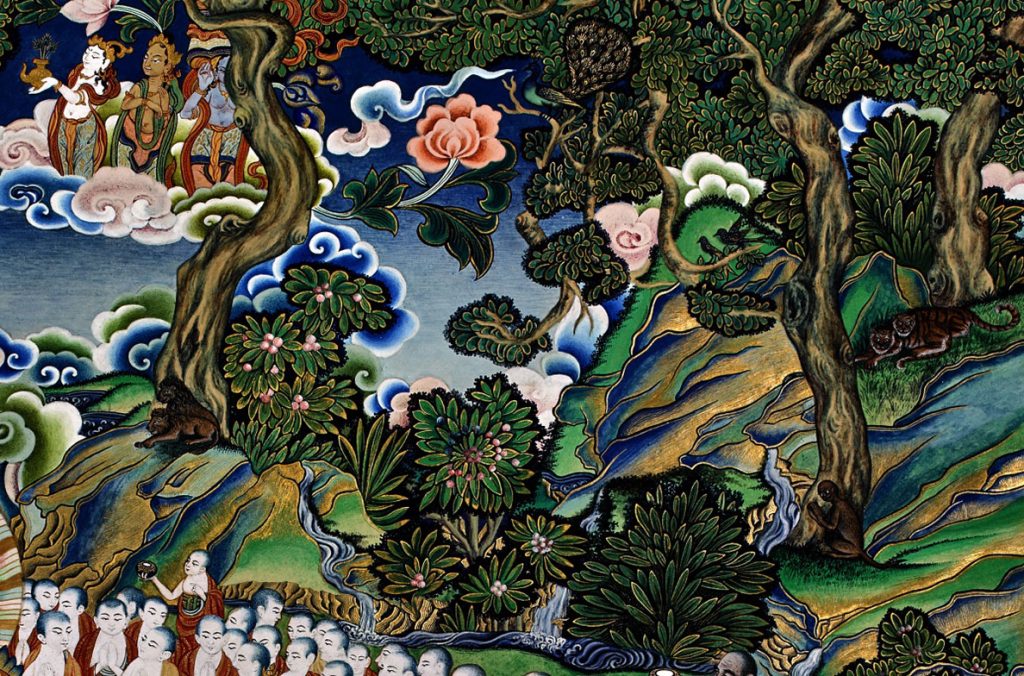
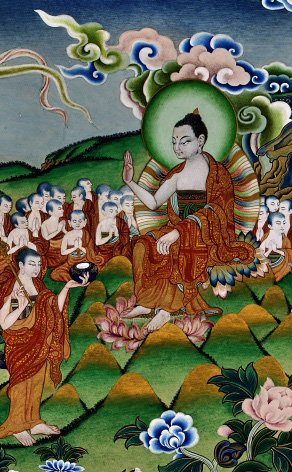
NARRATIVE PAINTING OF PREACHING BUDDHA
Mineral pigments on board.
By Siddhimuni Shakya
28 x 38 inches
Siddhimuni was born to the famous artist, Anandamuni Shakya, who traveled to Tibet with the merchant Chaiti Ratna Shakya when he was ony 18 years old. He became well known within the artist community, the nobles of Lhasa and through an introduction by the regent to the 13th Dali Lama. His holiness recognized him as a ‘divinely inspired artist’ and rewarded him with some silver coins silk brocade, and most importantly an ample supply of the finest natural mineral pigments from one of the Potala’s ancient storerooms.[1] He practiced his art in Lhasa for two years, then returned to Kathmandu.
Over time he told me stories – that after his father Anandamuni’s passing he taught himself and studied with Purna Man Chitrakar who was a renowned painter of his time, and decided to become a greater painter than his father by copying his father’s early paintings.
Siddhimuni Shakya went on to become the most renowned traditional paubha painter in Nepal and was a reclusive artist. I was introduced to him by my friend the late Puspa Ratna Shakya, and he translated Newari to English for me. It was not his habit to allow people to visit his workplace for which I was so privileged to sit quietly in his studio. The several occasions when I was invited in, which I took as a great privilege – it was like being invited into the ‘inner sanctum’ of a medieval European master’s atelier.
Surrounded by his paintings I sat quietly watching the master at work. He was famously known for his fine details, painted with a one-hair brush. I noticed that he held his breath or was breathing very shallow in order to control his brush strokes. When he showed his work he always had a magnifying glass by his side, required for the untrained eye to see his fine details.
I recall the day that he had several finished paintings hanging on his atelier wall, a black and white Vajrajogini, a Green Tara, a Bhairab and a narrative painting of the Buddha preaching to the Sangha. I had never seen then or to date a narrative painting with the Buddha preaching to so many monks, 182 in total. The paintings were all masterfully done. I was drawn to the Preaching Buddha, for its peaceful ambiance combined with the details that he was famous for. One day I broached him with the most difficult of questions, would he sell me a painting and could it be the narrative painting of the Preaching Buddha? He agreed and that set off my journey of finding collecting his works and to try to find his fathers work of this preaching Buddha.
One day I followed a lead, which brought me into a Newar’s home, where on the wall before me was the original narrative painting of the Preaching Buddha by Anandamuni Shakya his father! It was magnificently painted as well and demonstrated the Tibetan influence in his work with larger areas of space and a simpler style. This contrasted with his son’s penchant for details and filling in the blank spaces with leafy foliage in the trees, as demonstrated in the Preaching Buddha. I treasure the time that I spent with Siddhimuni. He rarely left his home and thus I was very honored when he and his son Surendra attended my wedding at my home. I cherish the miniature painted locket he gave me as a wedding present, which I still wear today.